



Building Compliance Capability From Scratch: How Akkar Helped Apptronik Prepare Apollo for Mass Production
How Akkar Helped Apptronik Prepare Apollo for Mass Production
Building Compliance Capability From Scratch: How Akkar Helped Apptronik Prepare Apollo for Mass Production
How Akkar Helped Apptronik Prepare Apollo for Mass Production
Apptronik is a humanoid robotics company headquartered in Austin, Texas, founded in 2016 as a spin-out from the University of Texas at Austin.
In under a decade, the company has grown to over 300 people and raised nearly $1 billion in funding, including a $405 million Series A and a $520 million extension round.
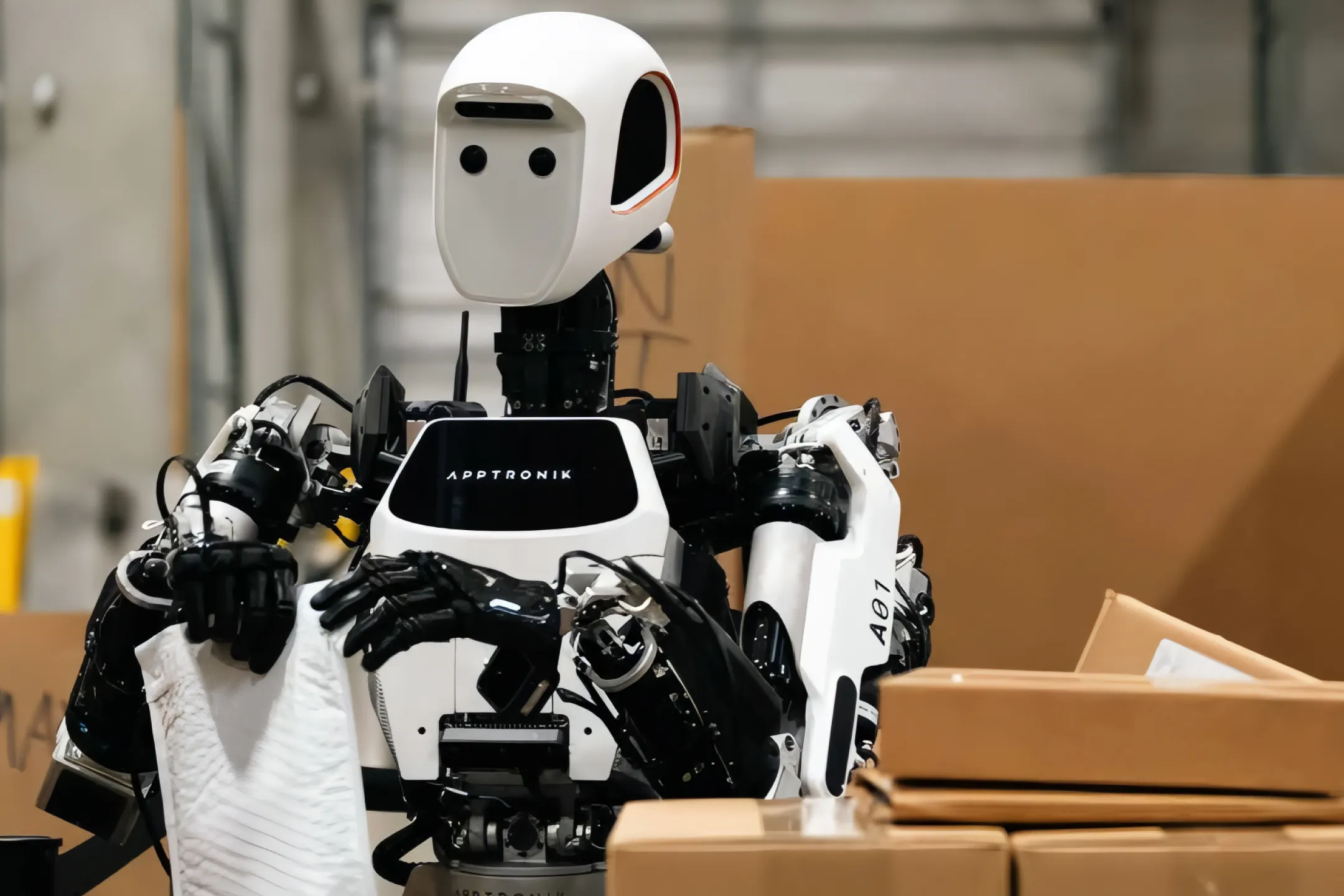
Its flagship product, Apollo, is a general-purpose humanoid robot deployed commercially through partnerships with Google DeepMind and Mercedes-Benz. As Apollo transitions from early deployment into scaled production, the operational demands on the business are changing quickly.
The Challenge: Building Compliance Infrastructure Ahead of Mass Production
Apptronik approached Akkar with a specific and unusually difficult mandate: hire a Staff Electrical Test Engineer capable of owning RF, EMI, and EMC strategy for Apollo as it
moves into mass manufacture, and stand up the internal testing capability to support it.
The complexity sat in the combination. The role required someone who had:
- Delivered EMI/EMC compliance on shipped, high-volume consumer or industrial products, not just prototypes or bench-level testing
- Built and run in-house testing facilities from scratch, including lab strategy, equipment specification, and process definition
- The seniority to hold oversight across large-scale, multi-programme production environments
Apptronik had no internal capability in this area and no active pipeline from their side.
Resourcing this function was proving difficult, and the timing was becoming critical. As Apollo moves toward volume manufacture, compliance stops being a downstream check and becomes a live operational risk — one that determines whether the product can legally ship at scale, and how quickly issues surfacing in production can be diagnosed and closed out.
This was not a compliance engineer hire. It was the foundation of an entire regulatory function.
The additional pressure point: the profile is genuinely rare. Most EMI/EMC specialists sit inside established consumer electronics primes or contract test houses. Very few have combined shipped-product experience with the greenfield capability to design a lab and a compliance strategy from the ground up. In robotics specifically, this work has historically been outsourced, meaning the internal pool of experienced practitioners is thin.
Akkar’s Role: Translating Market Reality into Execution
1. Reframing the Brief Around Adjacent Industries
Rather than searching within robotics, where the depth of experience Apptronik needed does not concentrate, we mapped talent across the industries where EMI/EMC compliance on mass-manufactured product is a permanent, high-stakes discipline:
- Consumer electronics, particularly consumer audio and connected devices
- Robotics and automation, where mass-manufacture experience exists
- Other heavily regulated, high-volume manufacturing sectors where compliance is embedded in the product lifecycle
The judgement here was that the transferable capability — building labs, owning strategy, closing out compliance on shipped hardware — matters more than sector origin. Robotics-native candidates would have been a narrower and shallower pool.
2. Precision Headhunting Into a Passive Market
The role opened on 20 May. Within nine days, we had identified and engaged the successful candidate — a senior compliance specialist inside one of the world's leading consumer
audio manufacturers, a business whose EMI/EMC and RF discipline on shipped, high-volume consumer product is exactly the pedigree the brief demanded.
He was a passive candidate. He was not on the market, was well settled in his existing role, and had a defined long-term retirement pathway in place with his employer. The engagement began with a direct outbound call — one he initially flagged as potential spam — and turned, over the course of that first conversation, into a serious discussion about a genuinely different next chapter of his career. From ten shortlisted candidates, he emerged as the clear match.
3. Running a Compressed, Aligned Process With Relocation Built In
From first outreach to offer acceptance, the process ran in roughly four to five weeks. The fit was so precise on both sides that Apptronik took an additional day at offer stage to formally
create the role around Kenneth's specific skillset — a rare signal of alignment at senior level. The hire also required an interstate relocation. The candidate and his family moved to Austin ahead of his start, a process that ran alongside the offer stage and required close coordination throughout. Holding expectations tightly across brief, package, timeline, and relocation logistics is often the determining factor in senior passive-candidate hires: any drift erodes the case for someone leaving a settled position.
Operational & Commercial Impact
The candidate has only just started, so measurable performance outcomes will surface as the compliance function begins to take shape over the coming months. What the hire unlocks structurally, however, is already clear.
By bringing senior RF/EMI/EMC leadership in-house at this specific point in the company's trajectory, Apptronik gains:
- Ownership of compliance strategy ahead of scaled production, rather than reacting to it during ramp
- Internal capability to design and run its own testing infrastructure, reducing dependency on external contract test houses
- Senior oversight capable of holding EMI/EMC across multiple concurrent programmes
- Faster diagnosis and closure of compliance issues as they surface in production
- A foundation the compliance function can be built out from, rather than a single-role hire in isolation
For a humanoid robotics business moving from deployment into volume manufacture, this is a category of risk that has to be owned internally. External contractors can execute testing, but they cannot own the strategic decisions that determine whether a product ships on time and at cost.
"I recently had a very pleasant experience with Akkar, due to the interaction with my recruitment consultant, Kris Masters, who was an absolute pleasure to speak with. Our story started very strangely, as a 'potential spam' call, turning into a conversation about life- changing opportunities he was more than happy to present to me. After 10 minutes on the phone he connected me with a company that was looking for, for lack of a better explanation, me. Every single aspect of their needs matched my skillset perfectly, so perfectly they needed an extra day to create a new job opening before they sent me an offer.
This shows how well Kris was able to match skills, not just abilities, but the actual needs and wants of both parties.
After my first conversation with the company, Kris was in contact with me before I was even able to call my wife. We had some concerns and worries as anyone would with such a change, but Kris was in contact with the company right after our call. Over the next few weeks, Kris was my absolute best friend — he was able to land me exactly what we initially
spoke of: an absolutely life-changing opportunity.
After saying all of this, I can sum it up into a simple statement: Akkar really matches skilled people with the right opportunities they will excel in, and Kris Masters will work night and day to make sure that is a true statement. I thank them all for their services as my family now gets to live a better life while I get to enjoy the job of my dreams. Take that call — it can change your life."
Apptronik is a humanoid robotics company headquartered in Austin, Texas, founded in 2016 as a spin-out from the University of Texas at Austin.
In under a decade, the company has grown to over 300 people and raised nearly $1 billion in funding, including a $405 million Series A and a $520 million extension round.
Its flagship product, Apollo, is a general-purpose humanoid robot deployed commercially through partnerships with Google DeepMind and Mercedes-Benz. As Apollo transitions from early deployment into scaled production, the operational demands on the business are changing quickly.
The Challenge: Building Compliance Infrastructure Ahead of Mass Production
Apptronik approached Akkar with a specific and unusually difficult mandate: hire a Staff Electrical Test Engineer capable of owning RF, EMI, and EMC strategy for Apollo as it
moves into mass manufacture, and stand up the internal testing capability to support it.
The complexity sat in the combination. The role required someone who had:
- Delivered EMI/EMC compliance on shipped, high-volume consumer or industrial products, not just prototypes or bench-level testing
- Built and run in-house testing facilities from scratch, including lab strategy, equipment specification, and process definition
- The seniority to hold oversight across large-scale, multi-programme production environments
Apptronik had no internal capability in this area and no active pipeline from their side.
Resourcing this function was proving difficult, and the timing was becoming critical. As Apollo moves toward volume manufacture, compliance stops being a downstream check and becomes a live operational risk — one that determines whether the product can legally ship at scale, and how quickly issues surfacing in production can be diagnosed and closed out.
This was not a compliance engineer hire. It was the foundation of an entire regulatory function.
The additional pressure point: the profile is genuinely rare. Most EMI/EMC specialists sit inside established consumer electronics primes or contract test houses. Very few have combined shipped-product experience with the greenfield capability to design a lab and a compliance strategy from the ground up. In robotics specifically, this work has historically been outsourced, meaning the internal pool of experienced practitioners is thin.
Akkar’s Role: Translating Market Reality into Execution
1. Reframing the Brief Around Adjacent Industries
Rather than searching within robotics, where the depth of experience Apptronik needed does not concentrate, we mapped talent across the industries where EMI/EMC compliance on mass-manufactured product is a permanent, high-stakes discipline:
- Consumer electronics, particularly consumer audio and connected devices
- Robotics and automation, where mass-manufacture experience exists
- Other heavily regulated, high-volume manufacturing sectors where compliance is embedded in the product lifecycle
The judgement here was that the transferable capability — building labs, owning strategy, closing out compliance on shipped hardware — matters more than sector origin. Robotics-native candidates would have been a narrower and shallower pool.
2. Precision Headhunting Into a Passive Market
The role opened on 20 May. Within nine days, we had identified and engaged the successful candidate — a senior compliance specialist inside one of the world's leading consumer
audio manufacturers, a business whose EMI/EMC and RF discipline on shipped, high-volume consumer product is exactly the pedigree the brief demanded.
He was a passive candidate. He was not on the market, was well settled in his existing role, and had a defined long-term retirement pathway in place with his employer. The engagement began with a direct outbound call — one he initially flagged as potential spam — and turned, over the course of that first conversation, into a serious discussion about a genuinely different next chapter of his career. From ten shortlisted candidates, he emerged as the clear match.
3. Running a Compressed, Aligned Process With Relocation Built In
From first outreach to offer acceptance, the process ran in roughly four to five weeks. The fit was so precise on both sides that Apptronik took an additional day at offer stage to formally
create the role around Kenneth's specific skillset — a rare signal of alignment at senior level. The hire also required an interstate relocation. The candidate and his family moved to Austin ahead of his start, a process that ran alongside the offer stage and required close coordination throughout. Holding expectations tightly across brief, package, timeline, and relocation logistics is often the determining factor in senior passive-candidate hires: any drift erodes the case for someone leaving a settled position.
Week 1, following briefing, benchmarking, and market mapping
Weeks 2–4
2 of 2
Approximately 4 weeks from search commencement to offer
Both positions filled; engineers UK-based, contracted through Akkar and deployed to Apptronik’s Google site, London.
Operational & Commercial Impact
The candidate has only just started, so measurable performance outcomes will surface as the compliance function begins to take shape over the coming months. What the hire unlocks structurally, however, is already clear.
By bringing senior RF/EMI/EMC leadership in-house at this specific point in the company's trajectory, Apptronik gains:
- Ownership of compliance strategy ahead of scaled production, rather than reacting to it during ramp
- Internal capability to design and run its own testing infrastructure, reducing dependency on external contract test houses
- Senior oversight capable of holding EMI/EMC across multiple concurrent programmes
- Faster diagnosis and closure of compliance issues as they surface in production
- A foundation the compliance function can be built out from, rather than a single-role hire in isolation
For a humanoid robotics business moving from deployment into volume manufacture, this is a category of risk that has to be owned internally. External contractors can execute testing, but they cannot own the strategic decisions that determine whether a product ships on time and at cost.
As robotics scales into mass manufacture, compliance moves from outsourced task to strategic function. Historically, EMI/EMC work in robotics has been contracted out because production volumes did not justify a permanent internal capability. That calculus changes at scale. Companies moving into humanoid volume production increasingly need in-house ownership of compliance strategy, lab infrastructure, and cross-programme oversight — and they need it built ahead of the ramp, not during it.
The right profile for early compliance leadership rarely sits inside the sector itself. The engineers who have built labs from scratch and shipped compliant product at volume are concentrated in mature consumer electronics and adjacent regulated manufacturing environments, not in robotics. Restricting the search to sector-native candidates guarantees a thinner pool and a weaker hire — a consumer audio pedigree of the kind the successful candidate brought is the point, not a detour from it.
Passive candidates settled into long-term plans can still be moved by the right proposition. The successful candidate was not looking, and the first call was almost declined as spam. What made the move viable was a specific opportunity — building a function from the ground up inside a company at a genuine inflection point — that could not be replicated inside his existing role. Precision matters more than volume in this segment of the market: nine days from brief to identified candidate, ten shortlisted, one hire, function established.
"I recently had a very pleasant experience with Akkar, due to the interaction with my recruitment consultant, Kris Masters, who was an absolute pleasure to speak with. Our story started very strangely, as a 'potential spam' call, turning into a conversation about life- changing opportunities he was more than happy to present to me. After 10 minutes on the phone he connected me with a company that was looking for, for lack of a better explanation, me. Every single aspect of their needs matched my skillset perfectly, so perfectly they needed an extra day to create a new job opening before they sent me an offer.
This shows how well Kris was able to match skills, not just abilities, but the actual needs and wants of both parties.
After my first conversation with the company, Kris was in contact with me before I was even able to call my wife. We had some concerns and worries as anyone would with such a change, but Kris was in contact with the company right after our call. Over the next few weeks, Kris was my absolute best friend — he was able to land me exactly what we initially
spoke of: an absolutely life-changing opportunity.
After saying all of this, I can sum it up into a simple statement: Akkar really matches skilled people with the right opportunities they will excel in, and Kris Masters will work night and day to make sure that is a true statement. I thank them all for their services as my family now gets to live a better life while I get to enjoy the job of my dreams. Take that call — it can change your life."
Interested in working with us?
Reach out to us, and our team will connect with you within 24 hours.


