

Why Software Is Becoming the Most Valuable Skill in Industrial Robotics
Industrial robotics has long been defined by hardware. But as automation becomes more intelligent, adaptive and autonomous, software is becoming the real competitive advantage.

Industrial robotics has long been defined by hardware. But as automation becomes more intelligent, adaptive and autonomous, software is becoming the real competitive advantage.
The Shift from Traditional Automation
For decades, industrial robotics has been synonymous with hardware. Bigger robot arms, faster actuators and more powerful machines have dominated factory floors around the world.
Today, however, the industry’s biggest competitive advantage is no longer mechanical engineering. It’s software.
Manufacturers are under increasing pressure to improve productivity, address labour shortages and handle greater product variation. As a result, robotics software engineering has emerged as one of the fastest-growing disciplines in industrial automation.
Traditional industrial robots have always excelled at repetitive tasks. Once programmed, they can perform the same movement thousands of times with exceptional accuracy.
The limitation is flexibility.
Any variation in the product, environment or workflow can require expensive reprogramming or entirely new production cells.
Modern manufacturing increasingly demands something different.Factories are producing high-mix, low-volume products where variation is the norm. That requires robots that can adapt rather than simply repeat.
Today’s robotics engineers are developing systems that combine:
- Computer vision
- Artificial intelligence
- Motion planning
- Sensor fusion
- Real-time control systems
- Machine learning
- Edge computing
Together, these technologies allow robots to understand their environment, compensate for variation and make intelligent decisions without constant human intervention.
Software Is Becoming the Brain of Industrial Robotics
One of the most significant developments in the sector is the emergence of vision-first robotic systems.Rather than relying on perfectly positioned parts and predefined coordinates, these systems use cameras, AI models and 3D perception to identify objects as they appear on the production line.
The robot can then generate the appropriate motion path dynamically instead of simply following a fixed programme.This represents a fundamental shift in industrial automation.Instead of adapting manufacturing processes to suit robots, software is enabling robots to adapt to manufacturing.
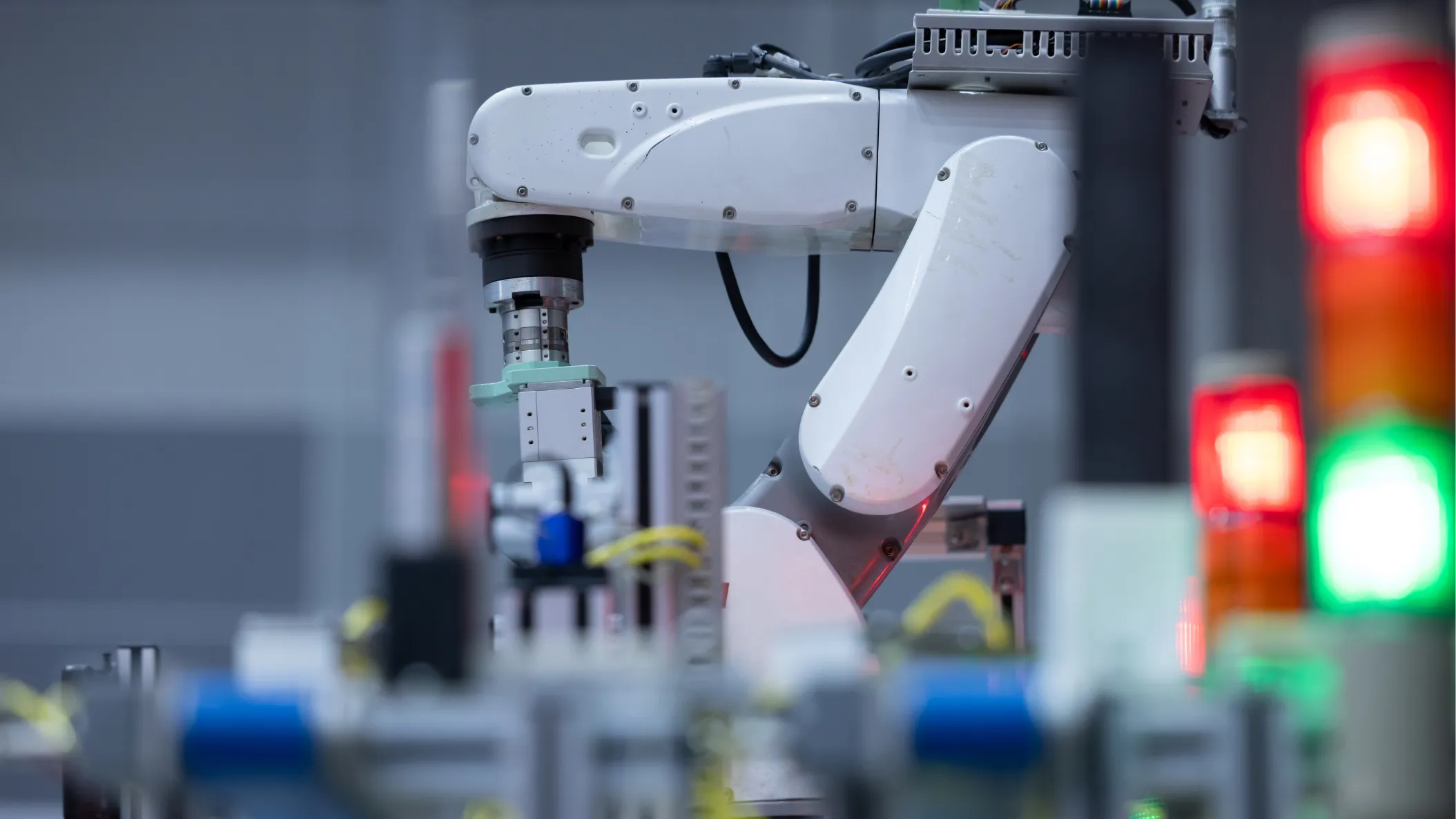
Robotics companies are already applying this approach to labour-intensive processes including metal finishing, grinding and material handling. By combining industrial robot arms with advanced computer vision and adaptive control software, they are demonstrating that intelligent software, rather than bespoke hardware alone, is increasingly becoming the differentiator.
The Rise of the Robotics Software Engineer
This evolution is changing what companies need from robotics engineers.Five years ago, expertise in robot programming alone may have been sufficient.Today, employers increasingly need engineers who can work across multiple disciplines, including:
- Python and C++
- ROS and ROS 2
- Computer vision
- AI and machine learning
- Motion planning
- Embedded systems
- Cloud robotics
- Distributed software architectures
- Real-time operating systems
The role has evolved beyond simply controlling robots.
Robotics software engineers are increasingly responsible for building scalable software platforms capable of managing fleets of robots, integrating factory data and deploying AI models directly onto industrial systems.
As robotic systems become more autonomous and safety-critical, strong software engineering practices become just as important as robotics expertise itself.
Why Manufacturers Are Investing
The business case is becoming increasingly compelling.Manufacturers continue to face skilled labour shortages alongside demands for faster production, improved quality and lower operating costs.
Intelligent robotics software creates opportunities to automate processes that have historically been too variable or complex for traditional automation.Rather than replacing people entirely, these systems can also enable people and machines to work together more effectively.
Robots can take on repetitive, physically demanding or hazardous tasks while operators focus on quality control, decision-making and exception handling.The result is not simply more automation. It is more flexible automation.
The Future Belongs to Intelligent Automation
Artificial intelligence is accelerating the pace of innovation across robotics.Foundation models, advanced perception systems and adaptive control algorithms are enabling robots to tackle increasingly complex tasks that once depended on human judgement.
As this continues, more of the value within an industrial robotics system will sit in the intelligence that determines how the machine sees, reasons and responds to the world around it.The next generation of industrial robotics won’t be defined by stronger motors or faster robot arms alone.
It will be defined by software that allows robots to see, reason, learn and adapt.For robotics software engineers, that creates one of the most significant opportunities in modern engineering.For manufacturers, it represents the next major leap in what can realistically be automated.
And for robotics companies competing to build that future, access to the engineers capable of developing these systems is becoming increasingly important.
Building a Robotics Software Team?
As robotics becomes more software-defined, the competition for engineers who can work across perception, autonomy, controls, embedded systems and AI is increasing.
Akkar works with robotics and advanced technology companies to find specialist engineering talent across the US, UK and Europe.
If you’re building or scaling a robotics software team, speak to Akkar about the talent you need to make it happen.
Morgan Harris - morgan@akkar.com
Interested in working with us?
Reach out to us, and our team will connect with you within 24 hours.